
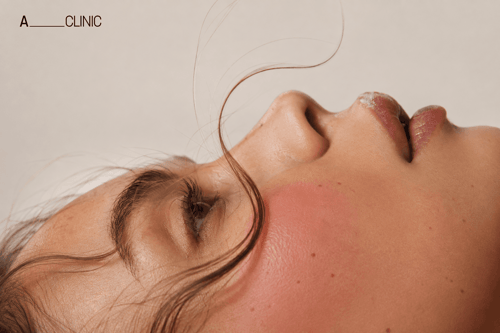

Rosacea is a chronic inflammatory skin condition affecting the face. It most commonly presents with redness of the central face, episodes of flushing, visible dilated blood vessels, and, in some people, inflammatory lesions that resemble acne. Burning, stinging, a sensation of heat, dryness, and increased skin sensitivity may also occur.
Rosacea follows a fluctuating course: periods of improvement may alternate with flare-ups. It is not possible to completely change the skin's predisposition to rosacea, but the condition can be well controlled with appropriate treatment, daily skincare, and protection from triggers.
Why does skin become sensitive with rosacea?
Rosacea involves changes in several skin systems at the same time: the vascular, immune, and nervous systems. The function of the epidermal barrier — the skin's outer protective layer — may also be impaired.
As a result, the skin can overreact to external stimuli. Even familiar cosmetics, hot water, friction, or sunlight may cause redness, burning, and discomfort.
Therefore, skincare for rosacea is not simply an addition to treatment. Gentle cleansing, regular moisturizing, and sun protection are important parts of managing the condition.
1. Cleanse your skin gently
For daily cleansing, it is best to choose gentle, soap-free products without abrasive particles that are designed for sensitive skin.
Wash your face with warm, but not hot, water. Apply the cleanser with your fingertips without using brushes, sponges, or other cleansing tools. After washing, gently pat the skin dry with a towel rather than rubbing it.
If cleansing regularly causes significant burning, tightness, or redness, the product is probably not suitable for your skin.
2. Don't skip moisturizer
Even if your skin is oily or you have inflammatory lesions, it may still need regular moisturizing.
Moisturizers help support the skin barrier, retain water, and reduce dryness and irritation. Simple formulas designed for sensitive skin without a large number of potentially irritating ingredients are preferable.
If applying moisturizer to damp skin causes burning, wait until your skin has completely dried after cleansing and then apply the product.
3. Use sunscreen
Ultraviolet radiation is one of the most common factors that can trigger rosacea flare-ups.
Use a broad-spectrum sunscreen with UVA and UVB protection and SPF 30 or higher. When spending extended periods outdoors, additional protection can be provided by a hat, sunglasses, and staying in the shade.
If regular sunscreens cause burning, you can try formulas designed for sensitive skin or products with mineral filters such as zinc oxide and/or titanium dioxide. However, what matters most is not that the filters are necessarily mineral, but that the particular SPF is well tolerated by your skin and used regularly.
4. The less irritation, the better
Skin affected by rosacea usually does not require aggressive cleansing or constant exfoliation.
Scrubs, facial brushes, vigorous rubbing, frequent use of acids, and other irritating procedures can increase skin sensitivity.
It is also worth being cautious with products containing alcohol, menthol, camphor, fragrances, witch hazel, and certain essential oils. This does not mean that there is a universal list of “forbidden” ingredients for every person with rosacea, but if a product causes persistent burning, itching, or redness, it is better to discontinue it.
5. You don't need to avoid all cosmetics
A diagnosis of rosacea does not mean that you need to completely stop using cosmetics.
The main criterion is how well you tolerate a particular product. Choose products designed for sensitive skin and introduce new products gradually. The more complicated your daily routine and the more active ingredients you use at the same time, the harder it is to identify the cause of irritation.
If redness is pronounced, green-tinted cosmetic products can help visually neutralize it.
6. Identify your triggers
Sun exposure, heat, overheating, alcohol, spicy foods, and certain other factors can trigger rosacea flare-ups. However, triggers vary from person to person.
You do not need to automatically eliminate everything that has ever been described as a rosacea trigger. If a particular food or situation does not cause your symptoms to worsen, there is usually no need to avoid it simply because you have rosacea.
It is more useful to observe your skin and identify your own recurring triggers.
7. Skincare does not replace treatment
Appropriate skincare helps reduce irritation and support the skin barrier, but it is not always enough to control inflammation associated with rosacea.
Depending on the manifestations of the condition, a dermatologist may prescribe topical or systemic medications, as well as device-based treatments to address persistent redness and visible dilated blood vessels.
Treatment is individualized: managing rosacea that mainly presents with redness may differ from treating rosacea with papules and pustules or ocular involvement.
A simple basic skincare routine
For most people, a good starting point is to keep the routine as simple as possible:
Morning: gentle cleansing → moisturizer if needed → SPF 30–50+.
Evening: gentle cleansing → medication prescribed by a doctor → moisturizer.
Specific products and the order of application may vary depending on the condition of the skin and the prescribed treatment.